Mailtrap alternatives: test inboxes and sending, compared
Mailtrap captures test mail in a sandbox and sends production mail. Teams look elsewhere when tests need real addresses that receive from the internet, a call that waits for the email, or cheaper sending.
Updated 7 min read
On this page (8)
Mailtrap is two products in one account: an Email Sandbox that captures test mail so it never reaches a real inbox, and Email Sending for production mail [2]. People searching for an alternative usually want one of the two, so this page covers both, with prices from Mailtrap's own pages. We make Runearc, so it sits in its own labelled box, not in the list. More switch guides are on the alternatives index.
Mailtrap alternatives at a glance
Listed alphabetically. Prices come from each provider's own page, listed in the sources.
Swipe sideways to see every column.
| # | Option | Best for | Free plan | First paid plan |
|---|---|---|---|---|
| 1 | Mailosaur | A full testing product: email and SMS, previews and SDKs for test frameworks | 14 day trial | Personal, from $20 a month billed annually |
| 2 | Mailpit (self hosted) | Catching the mail your app sends in local development and CI, with nothing leaving the machine | Free, you run it | None |
| 3 | MailSlurp | Many throwaway inboxes, SMS numbers and wait calls in 11 SDKs | 250 received emails, 100 inboxes created a month | Starter, $19.99 a month |
Runearc and Mailtrap, feature by feature
The Runearc prices below come from our pricing page. Paid plans are billed monthly in USD, and the free plan needs no card.
Swipe sideways to see the Mailtrap column.
| Feature | Runearc | Mailtrap |
|---|---|---|
| How test mail is received | Delivered for real to an inbox or the Catch-all on your private runearc.email domain | The sandbox captures mail sent to any address; it never reaches a real inbox [2] |
| A real address per test inbox | Any address on the Catch-all, on every plan | A dedicated inbox.mailtrap.io address per sandbox, from the Basic plan [3] |
| Waiting for an email | One request blocks up to 120 seconds and returns codes and links | List messages, 30 per page, or use webhooks [5] [4] |
| Received mail and the quota | Not counted; plans count sent emails | Sending plans: “a shared quota for sending and receiving combined” [2] |
| Inboxes on your own domain | Yes, with threads, reply, a shared team inbox and IMAP | Inbound Email, with a catch-all on your domain, on every plan [4] |
| HTML check, spam and blacklist reports | Yes, in the sandbox [7] | |
| Device previews | Paid add-on [2] | |
| SDKs | Node SDK coming to npm; REST, CLI and MCP today | Node.js, PHP, Ruby, .NET, Java, Python, Go, Elixir [7] |
| MCP server | Remote, with create_inbox and wait_for_email tools | A local Node.js command line server [6] |
| Free local sandbox | Mailtrap Local, open source [8] |
Prices at three volumes
Testing and sending are priced differently, so there are two tables. For testing, the volume is test emails received in a month; for sending, emails sent. Mailtrap's pricing page also shows lower annual prices for sending, but its plans page says annual billing for sending is available only by request to sales [2], so we use the monthly prices [1].
Swipe sideways to see the Mailtrap Sandbox column.
| Feature | Runearc | Mailtrap Sandbox |
|---|---|---|
| 500 test emails a month | Free (received mail is not counted) | Basic, $17 a month [1] |
| 5,000 test emails a month | Free (received mail is not counted) | Team, $42 a month [1] |
| 50,000 test emails a month | Free, within inbound rate limits; Pro at $9 if the tests also send | Business, $123 a month [1] |
Swipe sideways to see the Mailtrap Sending column.
| Feature | Runearc | Mailtrap Sending |
|---|---|---|
| 10,000 emails a month | Pro, $9 a month | Basic, $15 a month [1] |
| 50,000 emails a month | Pro, $9 a month | Basic, $20 a month [1] |
| 250,000 emails a month | Scale, $99 a month | Business, $200 a month [1] |
Two caveats on our side. The mail your tests receive was sent by something, and if that is your app sending through Runearc, those sends count against the plan. And Runearc plans stop at their limits instead of charging overage, so a month above 50,000 on Pro needs Scale.
What each does, and does not do
Mailtrap does: capture mail from staging so nobody gets a test email by accident, inspect it with HTML check and spam and blacklist reports [7], emulate bounces, send production mail with templates and 8 SDKs, and receive production mail through Inbound Email [4]. Its sandbox keeps a set number of messages per sandbox, oldest out first, from 10 on Free to 1,000 on Enterprise [2].
Mailtrap does not document a call that blocks until an email arrives; tests list messages and match them, or wait for a webhook [5] [4]. Its sending quota includes received mail [2].
Runearc does: real inboxes on your own domain or a private runearc.email domain, a Catch-all where every test makes up its own address, a wait endpoint that returns the code, sending over the API or SMTP from your verified domain, a shared support inbox and IMAP. Mail is kept until you delete it, unless you set a retention period.
Runearc does not capture outgoing mail, check HTML across clients, score spam, preview devices or emulate bounces. It sends from shared IPs; there is no dedicated IP option.
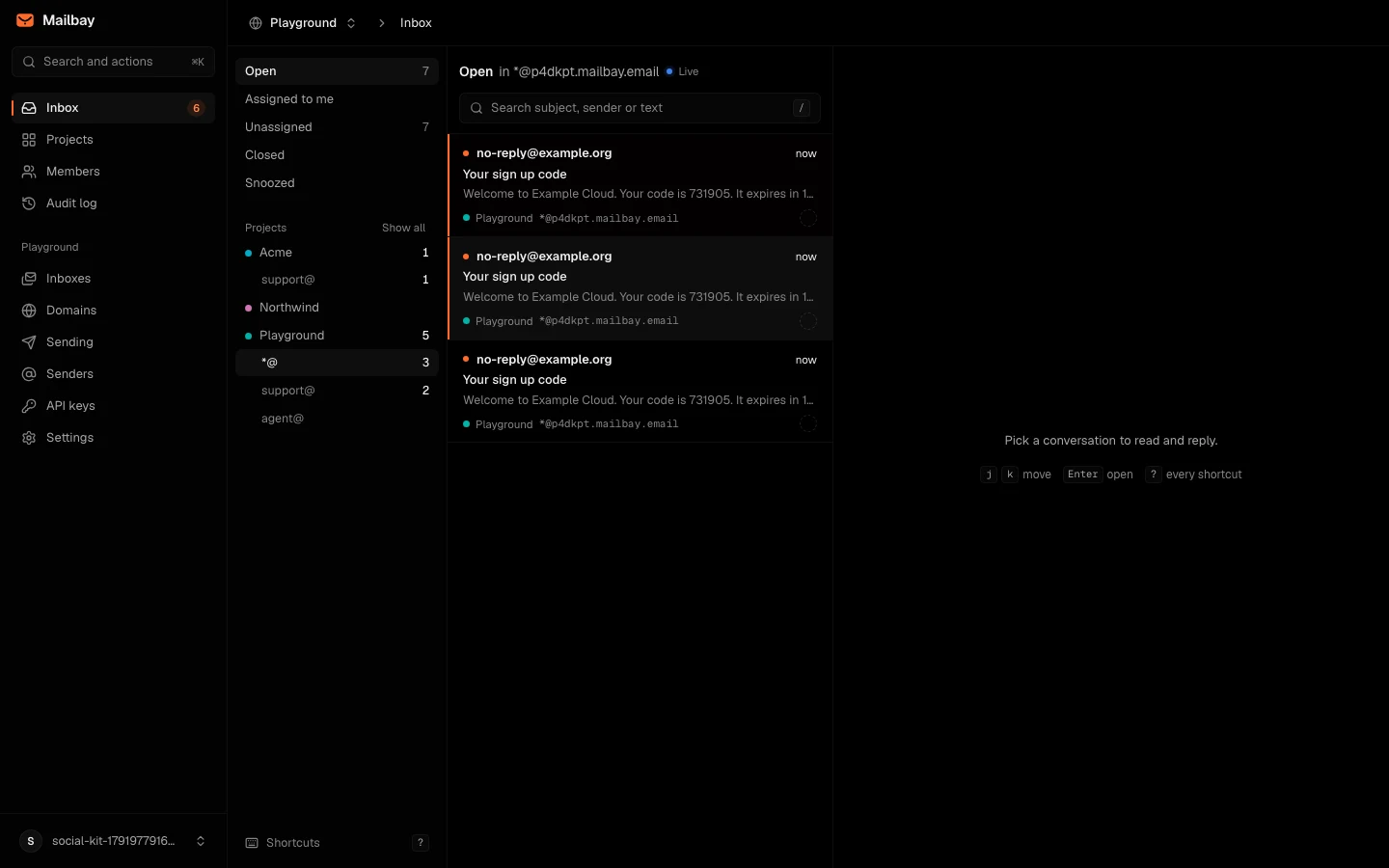
When Mailtrap is the better pick
- You need a safety net for staging. A capture sandbox guarantees that a staging run with real customer addresses never emails a real person. Runearc delivers mail, so it cannot be that net.
- Your QA checks the email itself, not only the flow: HTML support, spam and blacklist reports, device previews [7] [2].
- Your team already shares sandboxes with per sandbox credentials and up to 50 users on Business [2].
- You want an SDK in Java, .NET or Elixir, which Mailtrap has [7] and Runearc does not.
When Runearc is the better pick
- The test must receive mail from the internet, for example a sign up on a third party service, an agent registering for a tool, or an end to end test against production.
- You want one call instead of a polling loop. The wait returns the message with
codesandlinksalready pulled out, so the regex in your test goes away. - You also send app email and want received mail not to use the sending quota.
- You run support@ on the same domain and want it in the same workspace as the tests and the app mail.
Moving tests from the Mailtrap sandbox
- Get your test address space. Every workspace has a private
runearc.emaildomain whose Catch-all receives mail for any address under it; see the address space. A full access key reads it. - Change what the app sends to, not where it sends from. With the sandbox, the app points its SMTP at
sandbox.smtp.mailtrap.io[2] and any recipient is captured. With Runearc the app keeps its real sending setup, and the test signs up with an address such assignup-42@CODE.runearc.email. - Replace the poll. Where the test lists
/api/sandboxes/{id}/messagesuntil a match appears [5], call wait withtoset to the address, before you trigger the email. - Drop the regex. Read
codes[0]orlinks[0]from the response. - Keep Mailtrap for staging capture if you still need the safety net; the two do not conflict.
curl "https://api.runearc.com/v1/inboxes/$CATCH_ALL_ID/wait?to=signup-42@$CODE.runearc.email&timeout=60" \
  -H "Authorization: Bearer $RUNEARC_API_KEY"
# {"message": {...}, "codes": ["590214"], "links": ["https://..."]}
A full Playwright project with a passing run is on the Playwright integration page, and the reasoning behind one address per test is in catch-all inboxes for end to end tests. Moving sending as well? Check the domain with the free domain check first, then send one message to the deliverability test. If you are also weighing other testing services, the MailSlurp alternatives and Mailosaur alternatives pages use the same format.
Sources, read on November 19, 2026
- [1]Mailtrap pricing: mailtrap.io/pricing/
- [2]Mailtrap, billing plans and limits: docs.mailtrap.io/account-and-organization/billing/plans.md
- [3]Mailtrap, email address per sandbox: docs.mailtrap.io/email-sandbox/setup/email-address-per-sandbox
- [4]Mailtrap, Inbound Email overview: docs.mailtrap.io/inbound-email/overview.md
- [5]Mailtrap, sandbox API: get messages: docs.mailtrap.io/api-docs/email-sandbox
- [6]Mailtrap, MCP server: docs.mailtrap.io/for-ai-agents/tools/mcp-server.md
- [7]Mailtrap, docs home (SDKs, sandbox tools): docs.mailtrap.io
- [8]Mailtrap Local: docs.mailtrap.io/email-sandbox/local.md
- [9]Mailosaur pricing: mailosaur.com/pricing
- [10]MailSlurp pricing: app.mailslurp.com/pricing/
- [11]Mailpit: mailpit.axllent.org/
Prices change. If something here is out of date or wrong, email hello@runearc.com and we will fix it.
Questions
Is there a free Mailtrap alternative?
For local capture, Mailpit and Mailtrap's own open source Mailtrap Local are free and run on your machine. For tests that need a real address on the internet, Runearc's free plan has 3 inboxes and a Catch-all on a private runearc.email domain, and received mail does not count against the plan.
Does Runearc capture my app's outgoing mail like the Mailtrap sandbox?
No. Mailtrap's sandbox accepts mail for any address and never delivers it. Runearc delivers for real: your test sends to an address on your workspace's runearc.email domain or your own domain, and the mail arrives in an inbox you can wait on.
Does Runearc have a wait for email call?
Yes. GET /v1/inboxes/{id}/wait blocks for up to 120 seconds until a matching message arrives and returns it with one time codes and links already extracted. Mailtrap's docs describe listing messages or webhooks instead.
Is Runearc cheaper than Mailtrap for sending?
At the volumes we checked, yes: 10,000 or 50,000 emails a month is $9 on Runearc Pro against $15 and $20 on Mailtrap Basic, and 250,000 is $99 on Runearc Scale against $200 on Mailtrap Business, using Mailtrap's monthly prices.
What does Mailtrap do that Runearc does not?
HTML check, spam and blacklist reports, a bounce emulator, device previews, load testing and per sandbox SMTP credentials. If your QA process relies on those, keep Mailtrap for them.
Read next
- Mailosaur alternatives: 5 email testing tools, priced and comparedMailosaur is a complete testing product: email, SMS, previews and SDKs for every framework. This is the shortlist next to it: Mailpit, MailSlurp, Mailtrap and Runearc, priced at three volumes from each provider's own pages, with the setup steps and the cases where Mailosaur still wins.
- Playwright email testing with a catch-all inboxA Playwright fixture that gives every test its own email address and waits for the mail to arrive. No inboxes to create, no polling loop, and parallel workers never read each other's mail.
- Catch-all inboxes for end to end testsEmail is the step most end to end suites skip, because it is slow and flaky to check. A catch-all domain makes every test its own address, and a blocking wait removes the polling.
Put Runearc to work
Get inboxes, sending, your own domains and MCP in one workspace. The free plan includes 3 inboxes, 3,000 emails a month and 3 custom domains, with no card.